Friday, 22 March 2019

Explain how the representations in magazines reflect their contexts
Question 5 Explain how the representations in magazines reflect their contexts. Refer to The Big Issue covers you have studied to support your answer. [10]
The front covers of The
Big Issue are like adverts for the magazine, so in the same way as with
advertising they tend to reflect the influence of consumerism. The Big Issue
magazine is designed to help homeless people and so tends to have a more
political, more altruistic and
less consumerist focus.
The Big Issue always
uses a tagline of ‘a hand up not a hand out’, which makes people feel as though
they aren’t pitying vendors but giving them a helping hand towards the issues
of homelessness and making a difference to other people’s lives. One of the
magazines studied features Paddington
Bear, who is a popular, fictional character in children's literature. He first appeared on 13
October 1958 in the children's book A Bear Called Paddington written by British
author Michael Bond and illustrated by Peggy Fortnum and other artists.
This is mostly for promoting the film in a positive light (underneath the
masthead the date is shown - November 12th 2017, which is shortly before the
film was released- intertextuality, cultural) and he is happily smiling with a
friendly gesture of waving, almost welcoming the audience. However, it also
states that Paddington is from Peru and is now living in England, therefore an
immigrant. As an audience, we love Paddington and his story and accept him into
this country - this magazine is clearly stating that we should treat others the
same and that they are ‘one of us’. Furthermore, the anchorage text stresses
the importance of immigration, British and social values: Paddington is
labelled as an ‘icon’, therefore meaning he is influential and symbolic. It
labels everyone as equals and that we are all one - British pride. ‘The new
spirit of Christmas’ - he is going to change the festive season for the better,
he is a fun, happy and influential character - he makes a good difference, all
migrants do, in their own unique way. Additionally, the bold, daring font uses symbolism
within the Bear’s poor stamp strongly states that he has an identity and
further represents the idea of being ‘one of us’. The costume and props within
this magazine also highlights the importance of homelessness: a worn out hat, a
petite woolly coat and small briefcase. Despite the amusing and unusual side of
a bear wearing clothes, this further reinforces the idea of ‘migrating’ and the
stereotype of somewhat being homeless - has come from nothing, everything he
owns, all his possessions, are fitted within a small holder. Furthermore, this
also puts a positive light on homelessness and homeless people (what the big
issue believes in.) Within this
magazine the colour scheme is mostly primary - red, blue and yellow. They show
a deepening contrast but also complement each other. The blue jacket and
background represents the crisp atmosphere (setting and time - Christmas) but
also corresponds with the pride colours of Britain. The tonal red symbolizes love and passion, which needs to be shared towards all migrants. The golden
yellow represents happiness and further emphasizes the festive season. The
harsh lighting from the street light enables Paddington himself and the
magazine as a whole to attract the viewer but also highlights his importance as
he is an ‘icon’. The white snow also symbolizes purity and innocence, which
further explores the idea of letting migrants becoming one of us. Moreover,
Paddington bear is placed in the centre of the image, showing his importance
and the eye level camera shot signifies the social structure; everyone is equal
and we are one. Lastly, the imagery of Big Ben in the background, tying in a
political element almost towers over Paddington, which gives a sense of empowerment
but also shows that they are going to protect him.
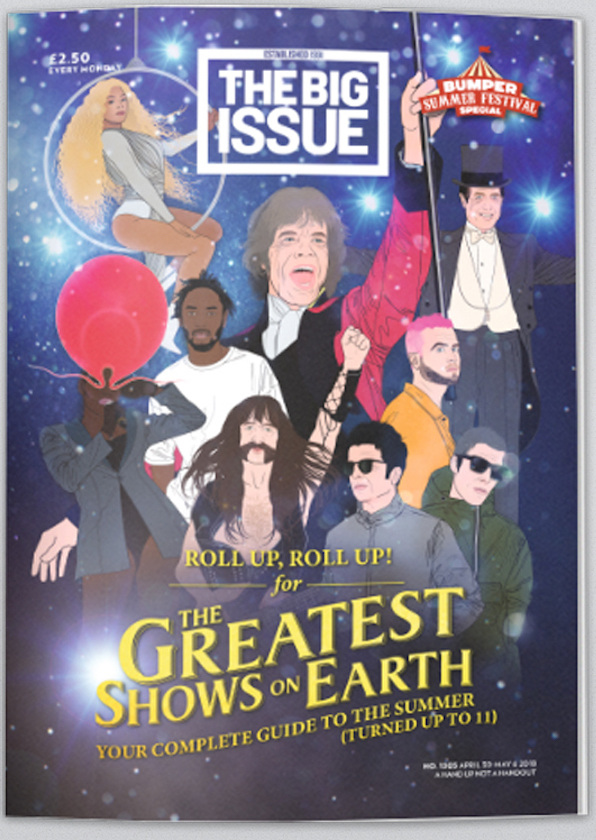
Another example would be the front cover magazine promoting The
greatest showman. It powerfully presents famous movie stars - Christopher Wylie,
Kendrick, Gallagher, Spinal tap guy,
Grace Jones, Beyoncé and Hugh Grant – who are strongly influential and
dramatically significant in today’s society. Since the release of the film, it
has had a huge impact on its meaningful message towards the change of society,
especially the song ‘this is me’. This appears
to have a future as an anthem for the marginalized, disenfranchised, the
bullied and the outcast. And in a year when “diversity” is on everyone’s minds
and lips, that means it could gain further attention and purpose. The characters find their sense of power and
pride – ‘we are who we are, and we’re going to own our own identity’, which is
what The Big issue supports strongly and further emphasizes their own personal
message towards homeless people and the society. Moreover, the magazine front cover is aiming to
attract everyone; to address the issues of class, race and inequality. They do
this by presenting characters of all races and colours, as well as the
characters that are in different classes. For example, Hugh Jackman’s character
(centred in the middle) came from nothing and made a name for himself through
performing in a circus. The women that does gymnastics on a hoop, in the film,
was black and poor and people treated her badly due to the lower class that she
was in. This sense of positivity enables an optimistic message, giving people
hope a purpose. This is further emphasized by the costumes: the colour
and style of the costumes vary to differentiate the characters and what they
look like. The film’s overall message presents that everyone is different and
that you shouldn’t change to please another person. Everyone is special in
their own way and people should not judge or look down on those that are seen
as ‘different’.
To conclude The Big Issue exists to offer homeless people, or individuals at risk of homelessness, the opportunity to earn a legitimate income, thereby helping them to reintegrate into mainstream society. They present these issues, as well as politcal, social and cultural elements, through their front covers, upon colour, costumes, typography, actors etc.
To conclude The Big Issue exists to offer homeless people, or individuals at risk of homelessness, the opportunity to earn a legitimate income, thereby helping them to reintegrate into mainstream society. They present these issues, as well as politcal, social and cultural elements, through their front covers, upon colour, costumes, typography, actors etc.

Thursday, 21 March 2019
big issue information
- language and representation
- social, cultural or political context
- niche magazine outside of the commercial market
- need to learn 2 big issue covers after Sept 2018
- an alternative to the mainstream
- usually, choose British orientated covers - national significance is important
magazines key words:
circulation - the number of copies a magazines sells - 200 million copies from 2016
readership - not just who buys the magazine but the total number of people likely to read it
mass audience - readership on a very large scale
niche audience - a narrow group of readers with a particular interest
subscription - where a reader pays for a set number of copies of a magazine in advance at a lower price and receives them by post
Big issue use a lot of intertextuality - working with lots of different media texts (films, magazine etc)
masthead - the title of the magazie
plug - text that 'plugs' a feature that will aprear in the magazine
puff - a story that is given promience on the conver
cover star - the 'star' featured on the cover
anchorage text - text that anchors the main image and gives it context/meaning
banner - text that runs across the lower section of the cover
skyline - text that runs across the top of the cover
advertising in magazine
producer, audience, adverts
without adverting, no magazine could survive. if a magazine did not contain ads, then its COVER PRICE would be three of four times greater.
the INCOME for a magazine comes from both sales and advertising. on average, advertising counts for 70% of a magazine income.
a magazine with a small CIRCULATION is more dependent on advertising than one with a large circulation.
The Big Issue and homelessness
about 100,000 copies of The Big Issue are sold every week in Britain
in 2013, the big issue vendors made more than £5 million
100 peoplle approach the big ussue foundation each week
theres more than 5,000 people homeless in Britain
the big issue has inspires similaar papers inmore than 120 countries
- social, cultural or political context
- niche magazine outside of the commercial market
- need to learn 2 big issue covers after Sept 2018
- an alternative to the mainstream
- usually, choose British orientated covers - national significance is important
- CLIFTS
- CLAMPS
- FAM - frame, angle, movement (magazines no movement)
magazines key words:
circulation - the number of copies a magazines sells - 200 million copies from 2016
readership - not just who buys the magazine but the total number of people likely to read it
mass audience - readership on a very large scale
niche audience - a narrow group of readers with a particular interest
subscription - where a reader pays for a set number of copies of a magazine in advance at a lower price and receives them by post
Big issue use a lot of intertextuality - working with lots of different media texts (films, magazine etc)
masthead - the title of the magazie
plug - text that 'plugs' a feature that will aprear in the magazine
puff - a story that is given promience on the conver
cover star - the 'star' featured on the cover
anchorage text - text that anchors the main image and gives it context/meaning
banner - text that runs across the lower section of the cover
skyline - text that runs across the top of the cover
advertising in magazine
producer, audience, adverts
without adverting, no magazine could survive. if a magazine did not contain ads, then its COVER PRICE would be three of four times greater.
the INCOME for a magazine comes from both sales and advertising. on average, advertising counts for 70% of a magazine income.
a magazine with a small CIRCULATION is more dependent on advertising than one with a large circulation.
The Big Issue and homelessness
about 100,000 copies of The Big Issue are sold every week in Britain
in 2013, the big issue vendors made more than £5 million
100 peoplle approach the big ussue foundation each week
theres more than 5,000 people homeless in Britain
the big issue has inspires similaar papers inmore than 120 countries
Monday, 18 March 2019
notch article
Notch Article
- Notch was celebrating raising £280,000 for three charities by making a new game in 60 hours.
- The second is selling 5 million copies of Mine craft (A blocky-looking game).
- He is name is Marcus Perrson however he is also referred to as 'Notch' meaning Jesus in the urban dictionary.
- He started Minecraft on his own in 2009.
- Then he formed the Video Game company Mojang.
- He deliberately left features out to entice the audience to interact with one another.
- Every Friday he would introduce updates, which was perfectly timed for people to relax and enjoy playing this emerging game over the weekend.
- Due to Perrsons PayPal account financially exploding they froze his account as they suspected fraud.
- On January 12th 2011 Minecraft surpassed a million units sold.
- By april, it was two million units.
- August it was three million.
- A few days before November it had surpassed four million copies!
- Then Minecon was created for all the fans and lovers to go and express themselves among one another.
Tuesday, 12 March 2019
Monday, 11 March 2019
Friday, 8 March 2019
genres/types of video games
RPG - Role play game e.g. sims
SPORTS - e.g. NBA, Fifa
STRATEGY - fortnite, Tetris
ACTION/AVENTURE - Zelda
CONSTRUCTION/STRATEGY/BUILDING - Minecraft
FPS - First person shooter e.g counterstrike
SIMULATION -
HORROR - e.g. 5 nights at Freddies
PUZZLE SOLVING - e.g. portal
CHILDREN'S - e.g. Minecraft
SPORTS - e.g. NBA, Fifa
STRATEGY - fortnite, Tetris
ACTION/AVENTURE - Zelda
CONSTRUCTION/STRATEGY/BUILDING - Minecraft
FPS - First person shooter e.g counterstrike
SIMULATION -
HORROR - e.g. 5 nights at Freddies
PUZZLE SOLVING - e.g. portal
CHILDREN'S - e.g. Minecraft
Subscribe to:
Posts (Atom)