Showing posts with label big issue. Show all posts

Wednesday, 23 October 2019

further notes on music video and big issue (grade a)

The purpose of music videos is to promote the artist to their audience. The representation of Corrine Bailey Rae (CBR) in her music video Stop Where You Are associates her with the idea of transcending prejudice and inequality. In the video the artist is seen to transcend prejudice. This is achieved by placing the artist in an urban environment encountering young characters who are stereotypically on the edge of society. We see the artist interact with these characters at different points in the video. For example, she goes up to the lonely girl and touches her shoulder as she walks past; she stops the girl gang from fighting by holding up her hands with the lyrics ‘stop where you are’ and she dances with the black youths at the end of the music video. The use of constructing two sides to the characters’ representation, firstly as a threat and then as people with qualities and skills, helps to reinforce that young people are approachable and valuable and that the artist not only believes this but can make the lives of these people better. These representations would appeal to the target audience either through identification with the characters, their age or cultural diversity, or the idea that the artist accepts them all regardless of social stereotyping. The representation of the artist through the production values used in the music video is another way in which the representations of CBR can be seen to appeal to her target audience. Although the video has a social realist, urban theme, the production values are artistic and the way the urban environment, the artist and the characters are represented is stylized. This suggests that the artist is concerned with urban and social commentary but is artistic and stylish regardless. This representation is achieved in a number of ways. The introduction of the artist is very conventional fading her in from a black screen, cutting to her face, her legs and back to her face when singing. The cross cutting of these shots of the artist with the urban location using low angle shots to reinforce the extreme angles of the building with glimpses of the blue sky above creates a meaningful connection between the artist and her environment and suggests that it is one that she, and her target audience, can transcend. The framing of the stairwells and corridors serves to create a sense of entrapment for the characters, especially when contrasted with the placement of the artist with the characters in more open spaces in the choruses and towards the end of the music video. A further way in which the artist is promoted to her target audience is by the use of costume. The red dress is a powerful symbol in the music video. The use of the red provides the only colour in the video and this contrasts vividly against the Exemplar 1 – Level 3 answer, 10 marks 

Examiner commentary This is a comprehensive response which addresses the question set and supports its arguments with a range of references and textual examples from the music video Stop Where You Are. There is demonstration of knowledge and understanding of representations and how this is constructed in the text with comprehensive, detailed and accurate knowledge and understanding of music video conventions and its form as a promotional tool. The response is a clear and balanced explanation of how representations are chosen to promote the artist with reference to how the technical aspects of the video are used in composition of star image. desaturated colour palette. This simple use of costume helps to construct the artist as feminine and unthreatening but also as powerful to her target audience and further enhances her appeal as she stands out against the everyday. To conclude, representations in music videos are chosen by producers to promote the artist to their audience. This is apparent in a number of ways in CBR’s music video which construct an image of the artist as powerful, open minded and as a musician with important social values and messages that will appeal to her audience.

BIG ISSUE question (Abba cover) 13/15

Analyse why The Big Issue magazine has used an intertextual approach to the referendum on its front cover. In your answer you must:
 • Analyse the use of intertextuality to create meaning in the source
 • Make judgements and reach a conclusion about the advantages of this use of intertextuality to The Big Issue magazine.  

The Big Issue magazine prides itself as niche and providing a critical view that is outside mainstream journalism. Intertextuality refers to the process of creating references to any kind of media text through another text. The intertextual reference to 70s pop band Abba and their song Winner Takes It All to represent the referendum is to reflect the status and identity of the magazine, to appeal to the target audience and to give additional meaning to the referendum vote. One reason why The Big Issue magazine has used an intertextual approach could be to identify the magazine as niche and outside mainstream reporting. The use of the intertextual reference to Abba presents The Big Issue as a magazine that looks at events critically and would likely contrast with reports on the referendum found in newspapers or more mainstream magazines. This approach to reporting the referendum highlights that The Big Issue can be relied on to offer fresh perspectives on current affairs. The representation of the politicians as pop musicians also helps to position the magazine as informal and witty. The use of intertextuality through inclusion of the song’s lyrics is a further way in which the magazine has adopted a witty approach to the event. The lyrics have been adapted to reinforce the viewpoint each politician on the referendum. This shows that the magazine is confident that the lyrics have cultural significance and are well known by its readers. They are also assuming their target audience will have a good grasp of current affairs and will appreciate the personalised link between lyrics and politician. An intertextual approach through the use of text is further achieved with the issue’s headline: Winner Takes It All. This is used to develop the Abba reference and the band’s song but, in terms of the political context, it is also highlighting that the result of the referendum will only have one outcome and it will be significant for whichever side wins the vote. By using the intertextual approach with Abba in this way, The Big Issue has cleverly managed to satirize the event and the politicians involved, yet remain impartial politically. This helps the magazine to take a more neutral position on the referendum and offers balance for their target audience. This is important because, as a charity, The Big Issue wouldn’t want to alienate readers for fear of disadvantaging the street vendors who sell the magazine. From this front cover, it is evident that the intertextual approach helps to identify The Big Issue as a provocative magazine that provides independent journalism and in doing so, is able to challenge people’s perceptions. A further reason why intertextuality has been used by The Big Issue magazine is to address and appeal to their target audience. The magazine’s audience is 72% ABC1 and 43% AB. This indicates their target audience are likely to be educated professionals and a sophisticated audience who will understand the intertextual reference to Abba, the personalisation of the lyrics and the satire they offer of the issues about the referendum. Through using this intertextual approach, the magazine addresses an aware audience and the references to Abba indicate the audience will enjoy recognising cultural references and satirical representations of current affairs and international politics. A final reason why The Big Issue may have used an intertextual approach on their front cover is to represent the referendum from a particular point of view and in an engaging way. In order to represent their story about the referendum vote, the magazine has placed the heads of the four politicians onto the bodies of Abba’s band members. The use of this intertextual reference, and the construction of the politicians as band members is very humorous. The heads of the politicians, the facial expressions they are making and their body language, through the performance of the original members, fit but look odd. The oversized heads on smaller bodies make the politicians look like puppets and foolish, indicating that the magazine doesn’t hold them in very high regard. It could also suggest that through using the intertextual reference to Abba, by presenting the politicians as a pop group performing on stage, it works as a metaphor to highlight the performance of the politicians courting popularity for their views on Leave or Remain. Through using this intertextual reference, The Big Issue is continuing the history of satirical cartoons that combine political images with popular culture which helps us to see the referendum in a new way, and leads us to question the motives of the politicians involved. Therefore, there are a number of reasons why The Big Issue magazine has used an intertextual approach to the referendum on its front cover. The identity of the magazine as intelligent, witty and both politically and culturally relevant is expressed through this approach and helps the magazine appeal to its educated and intelligent audience, whilst taking a satirical approach to the politicians involved in the referendum.

Wednesday, 29 May 2019

grade a essays on music videos and big issue

The purpose of music videos is to promote the artist to their audience. The representation of Corrine Bailey Rae (CBR) in her music video Stop Where You Are associates her with the idea of transcending prejudice and inequality. In the video the artist is seen to transcend prejudice. This is achieved by placing the artist in an urban environment encountering young characters who are stereotypically on the edge of society. We see the artist interact with these characters at different points in the video. For example, she goes up to the lonely girl and touches her shoulder as she walks past; she stops the girl gang from fighting by holding up her hands with the lyrics ‘stop where you are’ and she dances with the black youths at the end of the music video. The use of constructing two sides to the characters’ representation, firstly as a threat and then as people with qualities and skills, helps to reinforce that young people are approachable and valuable and that the artist not only believes this but can make the lives of these people better. These representations would appeal to the target audience either through identification with the characters, their age or cultural diversity, or the idea that the artist accepts them all regardless of social stereotyping. The representation of the artist through the production values used in the music video is another way in which the representations of CBR can be seen to appeal to her target audience. Although the video has a social realist, urban theme, the production values are artistic and the way the urban environment, the artist and the characters are represented is stylized. This suggests that the artist is concerned with urban and social commentary but is artistic and stylish regardless. This representation is achieved in a number of ways. The introduction of the artist is very conventional fading her in from a black screen, cutting to her face, her legs and back to her face when singing. The cross cutting of these shots of the artist with the urban location using low angle shots to reinforce the extreme angles of the building with glimpses of the blue sky above creates a meaningful connection between the artist and her environment and suggests that it is one that she, and her target audience, can transcend. The framing of the stairwells and corridors serves to create a sense of entrapment for the characters, especially when contrasted with the placement of the artist with the characters in more open spaces in the choruses and towards the end of the music video. A further way in which the artist is promoted to her target audience is by the use of costume. The red dress is a powerful symbol in the music video. The use of the red provides the only colour in the video and this contrasts vividly against the Exemplar 1 – Level 3 answer, 10 marks 

Examiner commentary This is a comprehensive response which addresses the question set and supports its arguments with a range of references and textual examples from the music video Stop Where You Are. There is demonstration of knowledge and understanding of representations and how this is constructed in the text with comprehensive, detailed and accurate knowledge and understanding of music video conventions and its form as a promotional tool. The response is a clear and balanced explanation of how representations are chosen to promote the artist with reference to how the technical aspects of the video are used in composition of star image. desaturated colour palette. This simple use of costume helps to construct the artist as feminine and unthreatening but also as powerful to her target audience and further enhances her appeal as she stands out against the everyday. To conclude, representations in music videos are chosen by producers to promote the artist to their audience. This is apparent in a number of ways in CBR’s music video which construct an image of the artist as powerful, open minded and as a musician with important social values and messages that will appeal to her audience.

BIG ISSUE question (Abba cover) 13/15

Analyse why The Big Issue magazine has used an intertextual approach to the referendum on its front cover. In your answer you must:
 • Analyse the use of intertextuality to create meaning in the source
 • Make judgements and reach a conclusion about the advantages of this use of intertextuality to The Big Issue magazine.  

The Big Issue magazine prides itself as niche and providing a critical view that is outside mainstream journalism. Intertextuality refers to the process of creating references to any kind of media text through another text. The intertextual reference to 70s pop band Abba and their song Winner Takes It All to represent the referendum is to reflect the status and identity of the magazine, to appeal to the target audience and to give additional meaning to the referendum vote. One reason why The Big Issue magazine has used an intertextual approach could be to identify the magazine as niche and outside mainstream reporting. The use of the intertextual reference to Abba presents The Big Issue as a magazine that looks at events critically and would likely contrast with reports on the referendum found in newspapers or more mainstream magazines. This approach to reporting the referendum highlights that The Big Issue can be relied on to offer fresh perspectives on current affairs. The representation of the politicians as pop musicians also helps to position the magazine as informal and witty. The use of intertextuality through inclusion of the song’s lyrics is a further way in which the magazine has adopted a witty approach to the event. The lyrics have been adapted to reinforce the viewpoint each politician on the referendum. This shows that the magazine is confident that the lyrics have cultural significance and are well known by its readers. They are also assuming their target audience will have a good grasp of current affairs and will appreciate the personalised link between lyrics and politician. An intertextual approach through the use of text is further achieved with the issue’s headline: Winner Takes It All. This is used to develop the Abba reference and the band’s song but, in terms of the political context, it is also highlighting that the result of the referendum will only have one outcome and it will be significant for whichever side wins the vote. By using the intertextual approach with Abba in this way, The Big Issue has cleverly managed to satirize the event and the politicians involved, yet remain impartial politically. This helps the magazine to take a more neutral position on the referendum and offers balance for their target audience. This is important because, as a charity, The Big Issue wouldn’t want to alienate readers for fear of disadvantaging the street vendors who sell the magazine. From this front cover, it is evident that the intertextual approach helps to identify The Big Issue as a provocative magazine that provides independent journalism and in doing so, is able to challenge people’s perceptions. A further reason why intertextuality has been used by The Big Issue magazine is to address and appeal to their target audience. The magazine’s audience is 72% ABC1 and 43% AB. This indicates their target audience are likely to be educated professionals and a sophisticated audience who will understand the intertextual reference to Abba, the personalisation of the lyrics and the satire they offer of the issues about the referendum. Through using this intertextual approach, the magazine addresses an aware audience and the references to Abba indicate the audience will enjoy recognising cultural references and satirical representations of current affairs and international politics. A final reason why The Big Issue may have used an intertextual approach on their front cover is to represent the referendum from a particular point of view and in an engaging way. In order to represent their story about the referendum vote, the magazine has placed the heads of the four politicians onto the bodies of Abba’s band members. The use of this intertextual reference, and the construction of the politicians as band members is very humorous. The heads of the politicians, the facial expressions they are making and their body language, through the performance of the original members, fit but look odd. The oversized heads on smaller bodies make the politicians look like puppets and foolish, indicating that the magazine doesn’t hold them in very high regard. It could also suggest that through using the intertextual reference to Abba, by presenting the politicians as a pop group performing on stage, it works as a metaphor to highlight the performance of the politicians courting popularity for their views on Leave or Remain. Through using this intertextual reference, The Big Issue is continuing the history of satirical cartoons that combine political images with popular culture which helps us to see the referendum in a new way, and leads us to question the motives of the politicians involved. Therefore, there are a number of reasons why The Big Issue magazine has used an intertextual approach to the referendum on its front cover. The identity of the magazine as intelligent, witty and both politically and culturally relevant is expressed through this approach and helps the magazine appeal to its educated and intelligent audience, whilst taking a satirical approach to the politicians involved in the referendum.
Friday, 22 March 2019

Big Issues

Explain how the representations in magazines reflect their contexts


Question 5 Explain how the representations in magazines reflect their contexts. Refer to The Big Issue covers you have studied to support your answer. [10]


The front covers of The Big Issue are like adverts for the magazine, so in the same way as with advertising they tend to reflect the influence of consumerism. The Big Issue magazine is designed to help homeless people and so tends to have a more political, more altruistic and less consumerist focus. 
The Big Issue always uses a tagline of ‘a hand up not a hand out’, which makes people feel as though they aren’t pitying vendors but giving them a helping hand towards the issues of homelessness and making a difference to other people’s lives. One of the magazines studied features Paddington Bear, who is a popular, fictional character in children's literature. He first appeared on 13 October 1958 in the children's book A Bear Called Paddington written by British author Michael Bond and illustrated by Peggy Fortnum and other artists. This is mostly for promoting the film in a positive light (underneath the masthead the date is shown - November 12th 2017, which is shortly before the film was released- intertextuality, cultural) and he is happily smiling with a friendly gesture of waving, almost welcoming the audience. However, it also states that Paddington is from Peru and is now living in England, therefore an immigrant. As an audience, we love Paddington and his story and accept him into this country - this magazine is clearly stating that we should treat others the same and that they are ‘one of us’. Furthermore, the anchorage text stresses the importance of immigration, British and social values: Paddington is labelled as an ‘icon’, therefore meaning he is influential and symbolic. It labels everyone as equals and that we are all one - British pride. ‘The new spirit of Christmas’ - he is going to change the festive season for the better, he is a fun, happy and influential character - he makes a good difference, all migrants do, in their own unique way. Additionally, the bold, daring font uses symbolism within the Bear’s poor stamp strongly states that he has an identity and further represents the idea of being ‘one of us’. The costume and props within this magazine also highlights the importance of homelessness: a worn out hat, a petite woolly coat and small briefcase. Despite the amusing and unusual side of a bear wearing clothes, this further reinforces the idea of ‘migrating’ and the stereotype of somewhat being homeless - has come from nothing, everything he owns, all his possessions, are fitted within a small holder. Furthermore, this also puts a positive light on homelessness and homeless people (what the big issue believes in.)  Within this magazine the colour scheme is mostly primary - red, blue and yellow. They show a deepening contrast but also complement each other. The blue jacket and background represents the crisp atmosphere (setting and time - Christmas) but also corresponds with the pride colours of Britain. The tonal red symbolizes love and passion, which needs to be shared towards all migrants. The golden yellow represents happiness and further emphasizes the festive season. The harsh lighting from the street light enables Paddington himself and the magazine as a whole to attract the viewer but also highlights his importance as he is an ‘icon’. The white snow also symbolizes purity and innocence, which further explores the idea of letting migrants becoming one of us. Moreover, Paddington bear is placed in the centre of the image, showing his importance and the eye level camera shot signifies the social structure; everyone is equal and we are one. Lastly, the imagery of Big Ben in the background, tying in a political element almost towers over Paddington, which gives a sense of empowerment but also shows that they are going to protect him.

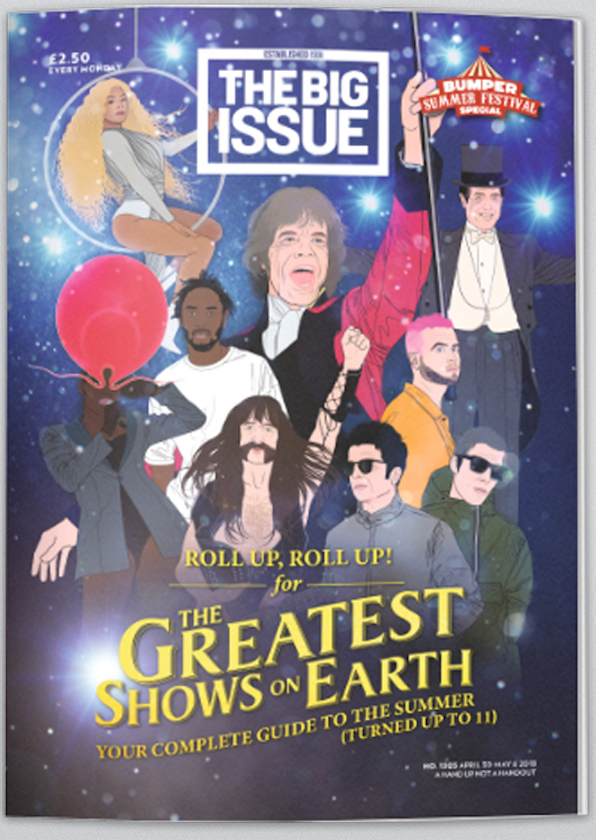
Another example would be the front cover magazine promoting The greatest showman. It powerfully presents famous movie stars - Christopher Wylie, Kendrick, Gallagher, Spinal tap guy, Grace Jones, BeyoncĂ© and Hugh Grant – who are strongly influential and dramatically significant in today’s society. Since the release of the film, it has had a huge impact on its meaningful message towards the change of society, especially the song ‘this is me’. This appears to have a future as an anthem for the marginalized, disenfranchised, the bullied and the outcast. And in a year when “diversity” is on everyone’s minds and lips, that means it could gain further attention and purpose. The characters find their sense of power and pride – ‘we are who we are, and we’re going to own our own identity’, which is what The Big issue supports strongly and further emphasizes their own personal message towards homeless people and the society. Moreover, the magazine front cover is aiming to attract everyone; to address the issues of class, race and inequality. They do this by presenting characters of all races and colours, as well as the characters that are in different classes. For example, Hugh Jackman’s character (centred in the middle) came from nothing and made a name for himself through performing in a circus. The women that does gymnastics on a hoop, in the film, was black and poor and people treated her badly due to the lower class that she was in. This sense of positivity enables an optimistic message, giving people hope a purpose. This is further emphasized by the costumes: the colour and style of the costumes vary to differentiate the characters and what they look like. The film’s overall message presents that everyone is different and that you shouldn’t change to please another person. Everyone is special in their own way and people should not judge or look down on those that are seen as ‘different’.

To conclude The Big Issue exists to offer homeless people, or individuals at risk of homelessness, the opportunity to earn a legitimate income, thereby helping them to reintegrate into mainstream society. They present these issues, as well as politcal, social and cultural elements, through their front covers, upon colour, costumes, typography, actors etc. 


Thursday, 21 March 2019

big issue information

- language and representation
- social, cultural or political context
- niche magazine outside of the commercial market

- need to learn 2 big issue covers after Sept 2018
- an alternative to the mainstream
- usually, choose British orientated covers - national significance is important

- CLIFTS

- CLAMPS

- FAM - frame, angle, movement (magazines no movement)

magazines key words:
circulation - the number of copies a magazines sells - 200 million copies from 2016
readership - not just who buys the magazine but the total number of people likely to read it
mass audience - readership on a very large scale
niche audience - a narrow group of readers with a particular interest
subscription - where a reader pays for a set number of copies of a magazine in advance at a lower price and receives them by post

Big issue use a lot of intertextuality - working with lots of different media texts (films, magazine etc)

masthead - the title of the magazie
plug - text that 'plugs' a feature that will aprear in the magazine
puff - a story that is given promience on the conver
cover star - the 'star' featured on the cover
anchorage text - text that anchors the main image and gives it context/meaning
banner - text that runs across the lower section of the cover
skyline - text that runs across the top of the cover

advertising in magazine
producer, audience, adverts

without adverting, no magazine could survive. if a magazine did not contain ads, then its COVER PRICE would be three of four times greater.

the INCOME for a magazine comes from both sales and advertising. on average, advertising counts for 70% of a magazine income.

a magazine with a small CIRCULATION is more dependent on advertising than one with a large circulation.

The Big Issue and homelessness 

about 100,000 copies of The Big Issue are sold every week in Britain
in 2013, the big issue vendors made more than £5 million
100 peoplle approach the big ussue foundation each week
theres more than 5,000 people homeless in Britain
the big issue has inspires similaar papers inmore than 120 countries

Jean Baudrillard